





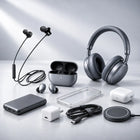
If you have been shopping for discounted electronics online, you have probably seen products labelled open box.
But what does open box actually mean?
Does it mean used?
Does it mean damaged?
Does it mean refurbished?
The answer is more nuanced than any of those.
Open box simply starts with the packaging
At the most basic level, an open-box product is one whose original retail packaging has been opened.
Once the manufacturer's original packaging or seal has been opened, the product can no longer be represented in the same way as untouched factory-sealed inventory.
That is why retailers often sell these products at a discount.
But open box does not describe one specific cosmetic condition.
Why do electronics become open box?
There are many possible reasons.
A customer may order a product and return it shortly afterwards.
The packaging may be opened during inspection.
The outer box may have suffered damage in logistics and handling while the product itself remains functional.
The item may have been removed from the packaging and then returned.
Some products may have been handled more than others.
As a result, two units of the exact same model can have different cosmetic conditions even though both are technically open-box products.
Does open box mean used?
In everyday conversation, people often distinguish between "open box" and "used."
A product may have opened packaging but show no meaningful signs of previous use.
Another product may have been handled or briefly used before being returned.
For shopping platforms and product feeds, however, condition terminology may work differently.
For example, platforms may classify products with opened original packaging under a "used" condition category even when the seller describes them to customers as open box.
This is why you may sometimes see:
Customer-facing condition: Open Box
while the ecommerce platform's technical product condition is:
Used
The two are not necessarily contradictory when the seller clearly explains what open box means.
Does open box mean refurbished?
No.
Open box and refurbished are different concepts.
A refurbished product has typically gone through a repair, restoration, or refurbishment process.
An open-box product may not have required any repair at all.
It may simply have been returned after the packaging was opened.
This distinction is important because some buyers automatically assume every discounted electronic product has been repaired.
That is not necessarily the case.
Why are open-box electronics cheaper?
The value of a retail product is partly connected to its presentation.
Customers generally expect to pay full retail price for:
factory-sealed packaging, untouched presentation, complete original packaging, and the normal retail experience.
Once the packaging has been opened, the product may need to be sold at a discount even if it functions normally.
The amount of discount usually depends on several factors:
product demand, age of the model, cosmetic condition, accessories, packaging condition, and current market price.
Are all open-box products the same?
Definitely not.
This is one of the most important things to understand.
Imagine two identical smartwatches.
The first has an opened box but almost no visible signs of handling.
The second has a few cosmetic marks on the strap or casing.
Both might be described as open box, but they should not necessarily be priced or graded the same way.
A useful open-box seller will therefore use condition grading.
Why condition grading matters
Condition grading gives you more information than the words "open box" alone.
For example, a seller might separate products into grades depending on cosmetic wear.
At Pruuvo, units can be offered under condition grades such as Superb, Good, and Okay depending on their individual condition.
Before buying, always read what each grade means.
Do not assume that every open-box unit will be cosmetically identical.
Does the original box matter?
For some customers, yes.
For others, not very much.
An open-box product may arrive in its original packaging, damaged original packaging, or another suitable protective package depending on the listing.
If the original box matters to you — for example, because you are buying the item as a gift — check this before ordering.
What about accessories?
Accessories are another area where open-box products can differ.
Depending on the item, the original retail package might contain:
a charging cable, power adapter, spare ear tips, documentation, straps, cases, or other accessories.
Read the listing carefully to understand exactly what is included.
Do not automatically assume every original retail accessory is present unless the product page says so.
Should you buy open box?
Open-box electronics are particularly attractive to buyers who prioritize the product itself over sealed packaging.
You may be comfortable accepting:
an opened box, light cosmetic marks, or slightly different packaging
in exchange for a lower price.
If that sounds reasonable to you, open-box products can offer strong value.
If pristine packaging is essential, factory sealed may be the better option.
What should you check before buying?
Before ordering an open-box product, look at its condition grade, current market price, included accessories, warranty information, return policy, and testing or inspection information.
A trustworthy listing should help you understand what you are buying before you pay.
Final takeaway
"Open box" does not automatically mean damaged, refurbished, or heavily used.
It means the product's original packaging has been opened, and the individual item's condition may vary.
The smartest way to buy open box is to focus on condition transparency rather than the label alone.